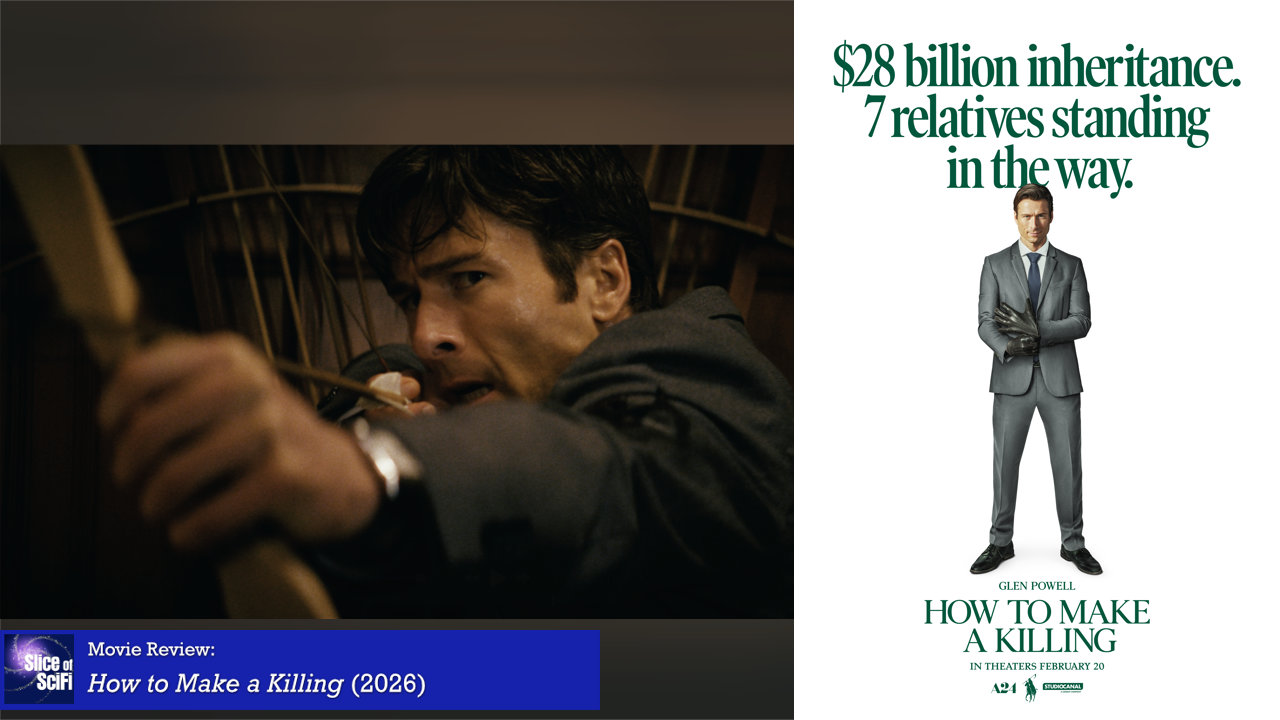
“How to Make a Killing” is a dark dramedy that relies on a solid performance by Glen Powell to make a possibly unlikeable character appealing. I believe that viewers’ feelings about this film will pivot around how much they like or dislike the ending, which is in no way obvious. A strong supporting cast supports Powell in this intriguing, unpredictable story.
The movie begins with a framing device. Becket Redfellow (Glen Powell) is in prison awaiting execution in a few hours for murder. A Catholic priest, Father Morris (Adrian Lukis) comes to comfort him. Becket proceeds to tell him how he came to be in this situation.
The Redfellows are an old-wealth family living on Long Island. They are led by unwavering, ruthless patriarch Whitelaw (Ed Harris). His daughter Mary (Nell Williams) falls in love at first sight with a cellist (Damien Wantenaar) who is performing at a family function. When her pregnancy test comes back positive, she and Whitelaw have a meeting. He tells her to either get rid of the fetus or leave the compound and family forever.
Nell leaves with her now husband to live in New Jersey. While she is giving birth, he has an embolism and dies. Now a single parent, she strives to make sure that Becket is raised to set his sights high. He plays piano and learns archery. He has a top-notch education.
It is at a piano recital that Becket first meets Julia (young Julia: Maggie Toomey; older Julia: Margaret Qualley), who is from a moneyed family. They have a flirtatious but conflicted relationship.
Mary becomes ill and no one from her family comes to see her at all. She tells Becket before she dies to go get his inheritance.
After her demise, Becket tells Father Morris that he was placed in the foster-care system. The next time he is on screen he is an adult working in an upscale men’s clothing store as a clerk. One day he encounters the adult Julia, who recognizes him and shows him her ring and, when she leaves, her fiancé through the window.
Becket is told that he is being transferred from Manhattan to go work in the warehouse in New Jersey. He decides to embark on his quest to eliminate the heirs to the Redfellow fortune.
The first up is Taylor Redfellow (Raff Law), who works in the family brokerage firm. Becket goes to his yacht and finds the hungover Taylor. He is told to get the anchor and uses it to pull Taylor to his death in the ocean. He then leaves, and is surprised both at the ease of the murder and that he is not even a suspect.
At the funeral for Taylor, Becket meets older cousin Warren (Bill Camp), who feels guilty about Mary’s exile. He offers Becket a job in the family firm, where Becket thrives.
When Becket meets cousin Noah (Zach Woods), a dilettantish photographer, and his wife Ruth (Jessica Henwick), sparks fly between Becket and Ruth. Noah must be killed in a way that does not let Ruth, Becket’s future fiancée, know that Becket was involved in any manner. Julia will soon re-enter the scene to complicate matters.
This picture hinges on the ability of Glen Powell to showcase the complex nature of the protagonist. He is capable of truly loving someone and being nice to them, as in the case of Ruth. Yet he also is ambitious enough to kill off obstacles to his final goal, complete wealth.
This performance relies as much on facial gestures and body language as it does on the dialogue and actions taken by Becket Redfellow. Powell does an admirable job pulling this off successfully. Part of this is due to his “it” factor as an actor: he clearly has charisma, charm and good looks. But another part is definitely due to his skills as a thespian.
Two other performances stand out in this film. The first is Bill Camp as cousin Warren. Considerably older than Becket, he just seems like a nice guy. He clearly regrets not reaching out to Mary when she was forced to leave. He does the right thing in offering a chance to Becket in the family firm. Camp’s naturalism in his performance allows for understated nuance in the character. He particularly displays being frazzled yet upbeat very well.
The other actor who warrants mentioning is Jessica Henwick as Ruth. This is a bravura effort. She is sweet but not completely naïve. She accepts being sexually attracted to Becket even when she is still married. She doesn’t break character ever but maintains a consistent portrayal that is emotional and real. In fact, she is probably the person who knows herself the best in this story.
I was disappointed by Margaret Qualley. Part of the problem is that she is not given enough backstory. I found her character to be annoyingly passive-aggressive. Even as her role in the screenplay becomes more prominent, she seems one-dimensional. I blame most of this on the script and the writers for not fleshing out her role as well as they did Ruth’s portrayal.
The Redfellow mansion is a construct. The interiors, according to the press notes, were filmed in existing estates. But the façade was made for the picture. Both aspects are impressive. The interiors seem fusty and overly ornate, a creation of a bygone era.
The framing device in the screenplay worked out well. It led to assumptions that later were proven to be false, mirroring how Becket could charm people into their own demise.
The ending was not what I would have predicted. But it is a possible logical extension of the characters involved in the movie. Yet, other endings are imaginable. So some audience members may feel cheated one way or the other. Despite this reality, it does not overshadow the complexity and subtle blending of comedy and drama that makes this picture work.
I think that young children would be bored by this film. But for those who like to guess what will happen in a murder mystery, this is right up your alley.
Four out of five stars
Disowned at birth by his obscenely wealthy family, blue-collar Becket Redfellow (Glen Powell) will stop at nothing to reclaim his inheritance, no matter how many relatives stand in his way.
Starring: Glen Powell, Margaret Qualley, Jessica Henwick, Bill Camp, Zach Woods, with Topher Grace, and Ed Harris
Written and Directed by: John Patton Ford
"How to Make a Killing" is a solid story, but with an ending to talk about
Summary
The ending was not what I would have predicted. But it is a possible logical extension of the characters involved in the movie. Yet, other endings are imaginable. So some audience members may feel cheated one way or the other. Despite this reality, it does not overshadow the complexity and subtle blending of comedy and drama that makes this picture work.
I think that young children would be bored by this film. But for those who like to guess what will happen in a murder mystery, this is right up your alley.





Leave a Reply