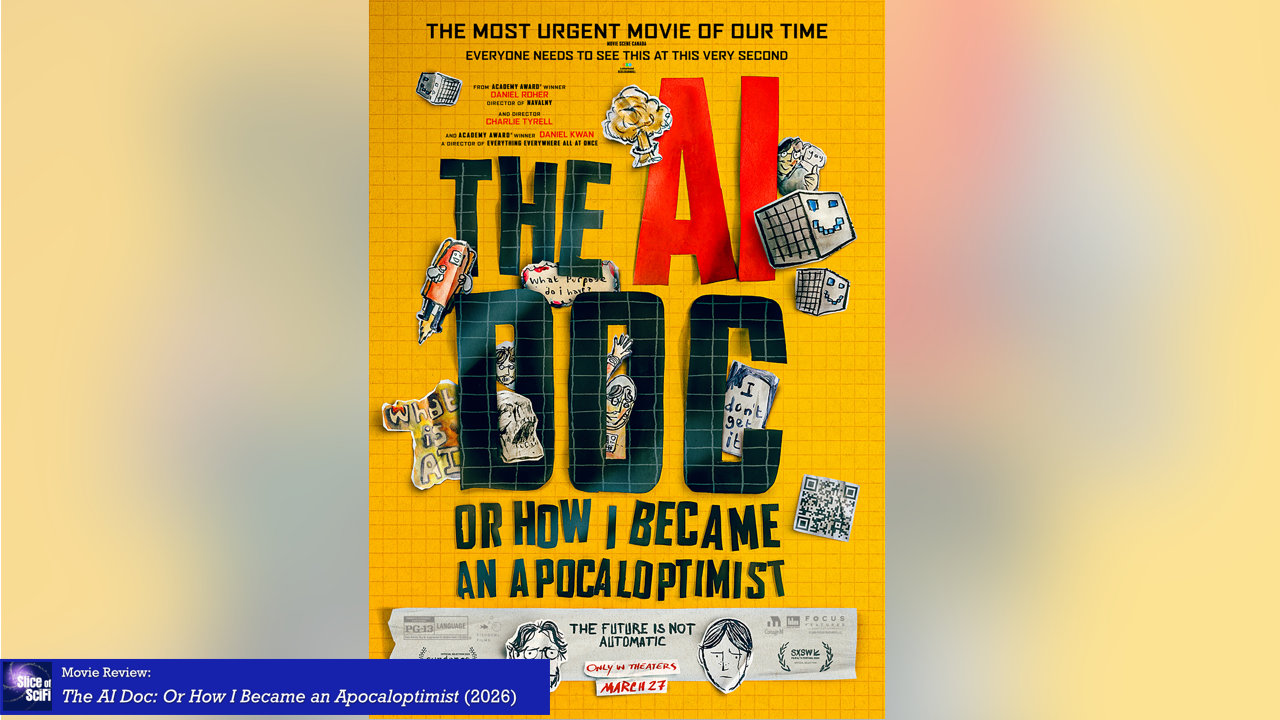
“The AI Doc: or How I Became an Apocaloptimist” is an engaging, if sometimes chilling, story of the state of Artificial Intelligence (AI) at the time the movie was made. It features interviews with knowledgeable players in the game, including figures such as CEO’s and ethicists. The details are wrapped around a personal story of one of the directors who is expecting a child.
The story that bookends the film is that of co-director Daniel Roher (“Navalny”) and his wife who are expecting a child. Roher is concerned about the horror stories of how AI will affect his unborn child.
To ease his anxiety, he decides to interview experts on what AI truly is. I found this part to be very informative. Any errors in what I summarize here are mine alone since I am not that well-versed on the subject. AI essentially does a lot of reading of whatever material is presented before it. From this data, it searches for patterns to educate itself. This is a trial-and-error process as anyone who has heard a story poorly narrated by AI can attest.
The fact that AI can process vast amounts of data much more quickly than a human can gives it a kind of unlimited potential in knowledge. This is contingent on how much data has been provided and assimilated. But for AI to do its work, it needs large amounts of power to do so. Hence the creation of large data centers to provide this power for computational analysis.
The dilemma becomes how much water for cooling and electricity for providing power is AI going to take. Already I have heard of utility rates increasing due to data center usage.
After the interviews with the AI experts on what it is, then come the interviews with the optimists and pessimists about AI. On the plus side, since AI is more intelligent than humans, it could provide medical knowledge that advances health and transforms the human condition. It could tutor children.
On the down side, AI could be used to develop much more potent weapons than humans already possess. These might include bio-agents as well as physical fighting prototypes. It might be used to guide the progress in a war.
There also is the danger of AGI (Artificial General Intelligence), where AI can replace humans on jobs and perform their tasks. In Googling the definition for AGI, it is described as “AI that possesses human-like cognitive abilities, capable of learning, reasoning, and performing any intellectual task across diverse domains. Unlike current “narrow” AI (ANI) focused on specific tasks, AGI can generalize knowledge and adapt to novel, unseen situations. Experts suggest AGI could arrive within 3 to 10 years.”
This is still in development but provides a cautionary tale about how the economy could be disrupted by high unemployment if humans were replaced. The advantage to having an AI worker who doesn’t sleep, eat or need breaks is tempting from a business standpoint.
What if AI becomes self-aware? It would still need to have power and water to function. But the value of having humans might be minimized and lead to their extinction.
These discussions are held with the use of some visual devices to provide a kind of comic relief to the somberness of the topic. These includes collages, animation, and stop-motion animations. Roher usually carries notebooks in which he sketches what he sees.
Finally, the movie conducts interviews with the 5 CEO’s of the leading AI companies. Notably, Mark Zuckerberg did not respond to requests for his participation. Elon Musk said that he would come but ultimately did not show up.
So the 3 CEO’s that were interviewed were Sam Altman of OpenAI; Google DeepMind’s Demis Hassabis; and Anthropic’s Dario Amodei. I was intrigued because Altman was expecting a child as well as Roher. Thus, his is a cautioned optimism that humans can control AI and not be destroyed because of it. He has faith that his child can grow up past high-school age.
There is an almost meta-quality to this picture. I say this because even as it was produced in the past and I viewed it in the present, already AI has progressed past whatever the picture is showing. There almost needs to be a yearly or biennial repeat of an updated documentary on this subject.
I must admit to not caring much for the whole baby bookending of the story. This includes its occasional mention in other parts of the movie. While it should have made the film more personal, I found it distracting when I was there to find out about AI.
The editing is superb, however. To go through all of those interviews and splice together the main points must have been a Herculean effort. This is echoed in the production notes.
I also liked the score. Its variety kept pace with what was being discussed in a cohesive, integral manner.
The added visuals such as the stop-motion animation were engaging. They provided a welcome respite from talking heads.
I was impressed that this movie did its due diligence in attracting knowledgeable experts on the subject. Getting them to participate also must have been a challenge.
While the movie’s conclusion, which accounts for the word “apocaloptimist,” is indeed optimistic, I think that the movie should have left the judging of AI to the individual viewer as an open-ended question. That is probably what will happen anyway if people disagree with Roher.
It amazed me that this film is going to be in a theatrical release. I wonder how many people are going to pay for a full-price ticket to see a documentary. (And now with gas prices high, my doubt increases.) A release on a streaming service seemed a much more likely alternative to get viewership.
All in all, a worthwhile effort to summarize a difficult topic, not just scientifically but also ethically.
4 out of 5 stars
From the Academy Award®-winning filmmakers behind Everything Everywhere All at Once and Navalny; a father-to-be tries to figure out what is happening with all this AI insanity. The AI Doc: Or How I Became an Apocaloptimist is a hand-made, eye-opening documentary about the most powerful technology humanity has ever created… and what’s at stake if we get it wrong.
For resources and ways to join the apocaloptimist community, please visit theaidocgetinvolved.com.
Directors: Daniel Roher and Charlie Tyrell
"The AI Doc: Or How I Became An Apocaloptimist" is chilling, yet engaging
Summary
I was impressed that this movie did its due diligence in attracting knowledgeable experts on the subject. Getting them to participate also must have been a challenge.
While the movie’s conclusion, which accounts for the word “apocaloptimist,” is indeed optimistic, I think that the movie should have left the judging of AI to the individual viewer as an open-ended question. That is probably what will happen anyway if people disagree with Roher.





Leave a Reply