BOSTON — A hopping robot that revolutionized thinking about walking robots, the first car to steer itself on a coast-to-coast U.S. trip, a kit that made it possible for anyone to build robots and the fictional android Data from “Star Trek: The Next Generation” are the 2007 inductees into Carnegie Mellon University’s Robot Hall of Fame®.
The four inductees — the one-legged Raibert Hopper, the NavLab 5 self-steering vehicle, the LEGO® Mindstorms kit and Lieutenant Commander Data — were announced on May 15 during a luncheon at the fourth annual RoboBusiness Conference and Exposition at the Hynes Convention Center in Boston.
“This is the first time since we established the Robot Hall of Fame in 2003 that most of the inductees are real robots rather than those of science fiction,” said Matt Mason, director of Carnegie Mellon’s Robotics Institute. “As much as we love fictional robots such as Data, those of us in the robotics field take heart when the real accomplishments of our colleagues get this well-deserved recognition.”
Robot Hall of Fame inductees are chosen by an international jury of leading thinkers and technology developers. Some members of the first three induction classes include the Mars Pathfinder Rover; Honda’s ASIMO robot; the HAL 9000 computer from “2001: A Space Odyssey”; the “Star Wars” duo of R2-D2 and C-3PO; and Gort, the metallic giant from “The Day the Earth Stood Still.”
“The great robots of science fiction, such as Gort, have a powerful hold on people’s imaginations, which is why we honor them and their creators,” said Don Marinelli, executive producer of Carnegie Mellon’s Entertainment Technology Center. “It’s precisely because Data was not confined by real-world limitations that he could address philosophical questions, such as whether a machine can have rights.”
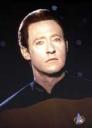 Lt. Cmdr. Data
Portrayed by actor Brent Spiner during the 1987–1994 run of “Star Trek: The Next Generation,” Data was the chief operations officer of the U.S.S. Enterprise and possessed both super-strength and an encyclopedic memory. “Data played a pivotal role on questions of robot ‘right to life’ matters and human/machine philosophies,” said juror Ray Jarvis, director of the Intelligent Robotics Research Centre at the Australian National University.
“In one episode,” recalled fellow juror Anne Balsamo, “Data is put on trial to determine whether he has the right to refuse to submit to a procedure that would disassemble him. During the trial, it is determined that Data is not ‘property,’ like a computer or a toaster, but rather a sentient life form entitled to rights of self-determination,” said Balsamo, managing director of the Institute for Multimedia Literacy at the University of Southern California.
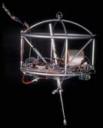 Raibert Hopper
No one would mistake the Raibert Hopper for sentient life, but experiments with the one-legged device in the early 1980s showed how a machine such as Data might someday walk with the agility of a human, rather than the plodding gait of early walking robots. When roboticist Marc Raibert established the Leg Laboratory at Carnegie Mellon in 1980 (he would move it to the Massachusetts Institute of Technology in 1986), he believed robots, just like humans, needed to rely on motion for stability — the principle of dynamic balance — if they were ever to become speedy.
The one-legged Hopper was ideal for studying dynamic balance because it could not stand still, but had to keep moving to stay upright. “The Raibert Hopper was the visionary effort that set the entire field of robotic locomotion in motion,” Mason said. The lessons learned with the Hopper proved central for biped, quadruped and even hexapod running. Raibert is now president of the robotics firm he founded, Boston Dynamics.
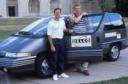 NavLab 5
This robot was one of a series of autonomous vehicles developed at Carnegie Mellon. NavLab 5 looked much like a standard GM minivan, but computers and video sensors made it capable of steering itself at legal speeds on everyday roads and highways.
NavLab 5’s crowning achievement was “No Hands Across America,” a 1995 cross-country tour on which it did 98 percent of the driving. “This was the first time that any autonomous vehicle had traversed so much different terrain,” said juror Chuck Thorpe, a NavLab pioneer who is now dean of Carnegie Mellon’s Qatar campus. “It’s not just a matter of purple mountains majesties. It’s a matter of painted lines on asphalt vs.reddish concrete vs. Botts’ dots reflective markers in California — all of which make a big difference in how the road looks to a robot.”
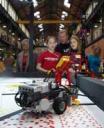 LEGO Mindstorms
This building set combined programmable bricks with electric motors, sensors and structural parts to create robots and other interactive systems. It went on sale retail in 1998. In a partnership with the MIT Media Lab, an educational version was also released. The next generation, LEGO Mindstorms NXT, was released last year with curriculum packages developed by Carnegie Mellon, Tufts University and Vernier Software.
“This kit did more to take creative robotics to the masses than just about any other retail product,” said juror Illah Nourbakhsh, associate professor in Carnegie Mellon’s Robotics Institute.
Juror Joanna Haas, director of Pittsburgh’s Carnegie Science Center, agrees. “LEGO has made robotics truly accessible to a broad audience — children and adults alike — and the Mindstorms sub-brand supports wildly popular play and learning in homes, classrooms and museums all around the world.”
High-resolution photos of the inductees are available at the CMU.edu Robot Hall of Fame Index Directory.




Leave a Reply