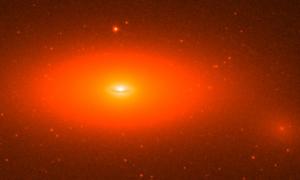
Scientists at University of Texas have found the most massive black hole yet discovered. Using the Hobby-Eberly Telescope, a team at the Austin’s McDonald Observatory have found a 17 billion solar mass behemoth residing at the heart of galaxy NGC 1277.
Located 220 million light-years away in the constellation Perseus, NGC 1277 is a lenticular galaxy only a tenth the size of the Milky Way. But somehow it contains the most massive black hole ever discovered, comprising a staggering 14% of the galaxy’s entire mass.
“This is a really oddball galaxy,” said Karl Gebhardt of The University of Texas at Austin, a team member on the research. “It’s almost all black hole. This could be the first object in a new class of galaxy-black hole systems.”
This galaxy and several more in the same study could change theories of how black holes and galaxies form and evolve. The work will appear in the journal Nature on Nov. 29.
The find comes out of the Hobby-Eberly Telescope Massive Galaxy Survey (MGS). The study’s endgame is to better understand how black holes and galaxies form and grow together, a process that isn’t well understood.
“At the moment there are three completely different mechanisms that all claim to explain the link between black hole mass and host galaxies’ properties. We do not understand yet which of these theories is best,” said Nature lead author Remco van den Bosch, who began this work while holding the W.J. McDonald postdoctoral fellowship at The University of Texas at Austin. He is now at the Max Planck Institute for Astronomy in Heidelberg, Germany.
The problem is lack of data. Astronomers know the mass of fewer than 100 black holes in galaxies. But measuring black hole masses is difficult and time-consuming. So the team developed the HET Massive Galaxy Survey to winnow down the number of galaxies that would be interesting to follow up on.
“When trying to understand anything, you always look at the extremes: the most massive and the least massive,” Gebhardt said. “We chose a very large sample of the most massive galaxies in the nearby universe,” to learn more about the relationship between black holes and their host galaxies.
Though still ongoing, the team has studied 700 of their 800 galaxies with HET. “This study is only possible with HET,” Gebhardt said. “The telescope works best when the galaxies are spread all across the sky. This is exactly what HET was designed for.”

This is quite a discovery you know because the thing about a black hole, it’s main distinguishing feature is, it’s black and thing about space, the color of space, your basic space color is, it’s black. So how are you supposed to see it?
Most black holes that have been discovered were actively feeding when the telescope was pointed in that direction or were found when people went back and looked at old data downloads that no one had the chance to look at. With this discovery, we could possibly be seeing the death of a galaxy by its black hole and, if this proves out to be true, it would help in understanding the relationship of galaxy and the black hole at the center of it and might gives us clues as to what might be necessary for it to grow. And to put it in perspective, if the black hole at the center of the Milky Way took up 14% of the mass of our galaxy, our distance from it would roughly be 15,000 light years instead of the current estimate of 30,000 light years.