NASA scientists celebrated the successful landing of the Curiosity rover on Mars Monday morning. The rover touched down on the Martian surface at 1:32 a.m. EST and a peril-filled seven-minute descent.
The rover touched down inside a crater where it will begin an ambitious mission to dig into the past of the Red Planet. Curiosity began transmitting back digital images from Mars as it touched down.
Cheers and applause echoed through the NASA Jet Propulsion Laboratory late Sunday after the most high-tech interplanetary rover ever built signaled it had survived a harrowing plunge through the thin Mars atmosphere.
“Touchdown confirmed,” said engineer Allen Chen. “We’re safe on Mars.”
Minutes after the landing signal reached Earth at 10:32 p.m. PDT, Curiosity beamed back the first black-and-white pictures from inside the crater showing its wheel and its shadow, cast by the afternoon sun.
“We landed in a nice flat spot. Beautiful, really beautiful,” said engineer Adam Steltzner, who led the team that devised the tricky landing routine.
It was NASA’s seventh landing on Earth’s neighbor; many other attempts by the U.S. and other countries to zip past, circle or set down on Mars have gone awry.
The arrival was an engineering tour de force, debuting never-before-tried acrobatics packed into “seven minutes of terror” as Curiosity sliced through the Martian atmosphere at 13,000 mph.
In a Hollywood-style finish, cables delicately lowered the rover to the ground at a snail-paced 2 mph. A video camera was set to capture the most dramatic moments — which would give Earthlings their first glimpse of a touchdown on another world.
Celebrations by the mission team were so joyous over the next hour that JPL Director Charles Elachi had to plead for calm in order to hold a post-landing press conference. He compared the team to athletic teams that participate in the Olympics.
“This team came back with the gold,” he said.
The extraterrestrial feat injected a much-needed boost to NASA, which is debating whether it can afford another robotic Mars landing this decade. At a budget-busting $2.5 billion, Curiosity is the priciest gamble yet, which scientists hope will pay off with a bonanza of discoveries and pave the way for astronaut landings.
“The wheels of Curiosity have begun to blaze the trail for human footprints on Mars,” said NASA chief Charles Bolden.
President Barack Obama lauded the landing in a statement, calling it “an unprecedented feat of technology that will stand as a point of national pride far into the future.”
Over the next two years, Curiosity will drive over to a mountain rising from the crater floor, poke into rocks and scoop up rust-tinted soil to see if the region ever had the right environment for microscopic organisms to thrive. It’s the latest chapter in the long-running quest to find out whether primitive life arose early in the planet’s history.
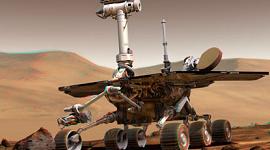
The voyage to Mars took more than eight months and spanned 352 million miles. The trickiest part of the journey? The landing. Because Curiosity weighs nearly a ton, engineers drummed up a new and more controlled way to set the rover down. The last Mars rovers, twins Spirit and Opportunity, were cocooned in air bags and bounced to a stop in 2004.
Curiosity relied on a series of braking tricks, similar to those used by the space shuttle, a heat shield and a supersonic parachute to slow down as it punched through the atmosphere.
And in a new twist, engineers came up with a way to lower the rover by cable from a hovering rocket-powered backpack. At touchdown, the cords cut and the rocket stage crashed a distance away.
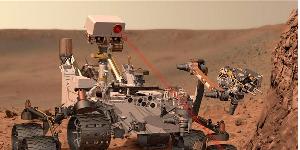
The nuclear-powered Curiosity, the size of a small car, is packed with scientific tools, cameras and a weather station. It sports a robotic arm with a power drill, a laser that can zap distant rocks, a chemistry lab to sniff for the chemical building blocks of life and a detector to measure dangerous radiation on the surface.
It also tracked radiation levels during the journey to help NASA better understand the risks astronauts could face on a future manned trip.
Over the next several days, Curiosity is expected to send back the first color pictures. After several weeks of health checkups, the six-wheel rover could take its first short drive and flex its robotic arm.
The landing site near Mars’ equator was picked because there are signs of past water everywhere, meeting one of the requirements for life as we know it. Inside Gale Crater is a 3-mile-high mountain, and images from space show the base appears rich in minerals that formed in the presence of water.
Previous trips to Mars have uncovered ice near the Martian north pole and evidence that water once flowed when the planet was wetter and toastier unlike today’s harsh, frigid desert environment.
Curiosity’s goal: to scour for basic ingredients essential for life including carbon, nitrogen, phosphorous, sulfur and oxygen. It’s not equipped to search for living or fossil microorganisms. To get a definitive answer, a future mission needs to fly Martian rocks and soil back to Earth to be examined by powerful laboratories.
The mission comes as NASA retools its Mars exploration strategy. Faced with tough economic times, the space agency pulled out of partnership with the European Space Agency to land a rock-collecting rover in 2018. The Europeans have since teamed with the Russians as NASA decides on a new roadmap.
Despite Mars’ reputation as a spacecraft graveyard, humans continue their love affair with the planet, lobbing spacecraft in search of clues about its early history. Out of more than three dozen attempts — flybys, orbiters and landings — by the U.S., Soviet Union, Europe and Japan since the 1960s, more than half have ended disastrously.
One NASA rover that defied expectations is Opportunity, which is still busy wheeling around the rim of a crater in the Martian southern hemisphere eight years later.



Leave a Reply