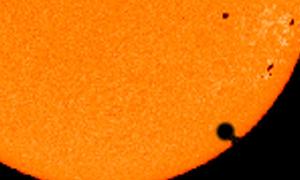
Astronomers are eagerly anticipating tomorrow evening’s transit of the planet Venus across the sun. At 6:03 PM EDT Tuesday, Venus will appear as a distinct black dot, like a mole on the sun’s cheek, near sunset.
And if you want to catch a glimpse of it, you’d better make plans to do so tomorrow. Miss it this time around and you won’t get a chance to do so for another hundred years.
A transit of Venus is among the rarest of astronomical events, rarer even than the return of Halley’s Comet every 76 years. Only six transits of Venus are known to have been observed by humans before: in 1639, 1761, 1769, 1874, 1882 and most recently in 2004.
Prior to local sunset, observers who are located over much of North America and the northwestern part of South America will be able to observe at least the opening stages of this most unusual celestial phenomenon
NASA is making plans to take advantage of the celestial event to calibrate some its instruments.
Since the points at which Venus will first touch and later leave the sun are precisely known, NASA’s Solar Dynamics Observatory can use this information to make sure its images are oriented to true solar North.
Calibrations throughout SDO’s two-year career have left scientists confident that the instruments are highly accurate – but new observations could help make sure that its orientation is accurate to within a tenth of a pixel.
The SDO team can also use the lightless center of Venus to help calibrate the point spread function of the telescope – a measure of how much light leaks from one pixel into others around it.
Since no light is emitted from the very center of Venus as it crosses the sun, it serves as a perfect test case for an area of the image where the pixels should remain black. By measuring how much light bleeds into those pixels from the rest of the sun, the SDO team will have a better idea of how to correct for that.
The measurements should also help scientists understand the black drop effect, in which a tiny black spot appears to connect Venus to the sun – an effect that confounded attempts to measure the exact position of Venus during transits in the 18th and 19th centuries.
And if you want to view the transit safely, NPR has some tips, including the biggest–don’t stare directly at the sun.

Well I for one plan on trying to view it myself with the kids, the weather is looking good here and I’ve assembled a projector type sun viewer for it. My quick test yesterday appeared to show some sunspots (which are just dots at the moment).
It you want to build one yourself my post about the build is here: http://laith.wordpress.com/2012/06/04/a-homemade-sun-viewer/
There a lot of great resources out there for viewing this once in a lifetime event.
I watched it from my pasture with my 12 yr old daughter.
I just used my little 4.5″ f/9 dob and a white light solar filter and it looked awesome!
We took my little homebrew viewer out to the park. We are fairly sure we saw it, and the two year old learned a new word “Sun”