• Home
  • Podcast
    • Specials
  • Interviews
  • Movie Reviews
  • TV Reviews
  • DVD Reviews
  • Columns
  • News
    • TV News
    • Film News
    • DVD News
    • Comics News
    • Online Entertainment News
    • Music News
    • Book News
    • Space News

Slice of SciFi

This is How We Geek Out: Interviews, Reviews & More

  • Writers, After Dark
  • The Babylon Podcast
  • Slice of SciFi TV
  • Charlie Jade Verse
  • Contact Us
    • About Us
Comets Caused Differences in Jupiter’s Moons

Comets Caused Differences in Jupiter’s Moons

January 27, 2010 By Mike Hickerson Leave a Comment

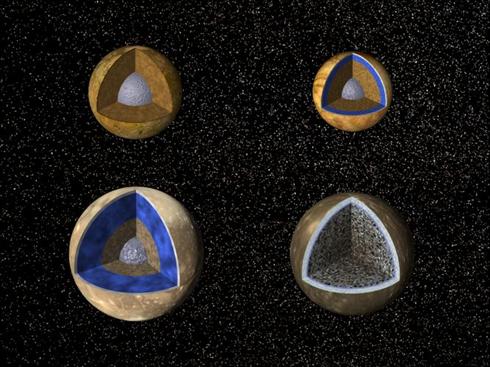
jupitermoonsScientists have taken a step closer to explaining why Jupiter’s moons are so different from each other.

A new study, published in the Nature Geoscience journal report, says that Jupiter’s Ganymede likely endured a double blasting of comets 3.8 billion years ago, explaining its difference from twin moon, Callisto.

In the report, scientist show that Jupiter’s gravity likely drew more, faster comets onto Ganymede, its closer moon, during a period called the “Late Heavy Bombardment” of the solar system.

Ganymede, some 3,270 miles wide, and Callisto, some 2,980 miles wide, are both icy moons of Jupiter and among the largest ones in the solar system. But Ganymede, which orbits some 665,000 miles from Jupiter, has a solid rocky core. Callisto, which travels on an orbit some 1,171,000 miles from the planet, does not. “The origin of the `Ganymede-Callisto dichotomy’ has puzzled scientists since the Voyager era,” three decades ago, says the study, because both moons formed from the same stuff, the same way, at the same time around the same planet.

In the study, the authors show the extra oomph of faster-traveling comets, accelerated by the closer proximity of Jupiter’s heavy gravity, would have been sufficient to completely melt the ice of Ganymede after an impact. That would allow heavy elements to sink, forming a core inside the moon.

Callisto, however, doesn’t receive quite as energetic a smacking around, leaving it a mixed ball of rock and ice. The difference supports earlier studies suggesting the comet disk that supplied much of the impact scars seen on the moon today must have weighed about 20 times as much as Earth.

Filed Under: Space News

Leave a Reply Cancel reply

Your email address will not be published. Required fields are marked *

Generic selectors
Exact matches only
Search in title
Search in content
Post Type Selectors
Search in posts

Slice

Follow Slice of SciFi

  • youtube
  • bluesky
  • twitter
  • facebook

Listen to Slice of SciFi

  • iheartradio
  • pocketcasts
  • playerfm

Subscribe to Podcast

Apple PodcastsSpotifyiHeartRadioPodchaserPodcast IndexTuneInRSS

  • Movie & TV Reviews

Recent Comments

  • Kristen on Journal Now Interview With “Surface” Co-Creator: “I was just talking about this in the car this morning, not for the first time. I grew up watching…”
  • Xander Rohrig on Check Out the Cupcake Games: “its dig dug”
  • Curt Myers on 4K Review: “Dogma” 25th Anniversary Special Edition brings a lost classic home again: “The best the movie has looked. It’s dialogue heavy so the Atmos track is rarely used. When it comes in…”
  • Summer Brooks on “FATE: The Winx Saga” writer Olivia Cuartero-Briggs talks adapting properties: “I requested it. I always get a little curious when TV shows or films get abandoned or canceled then continue…”
  • anh on “FATE: The Winx Saga” writer Olivia Cuartero-Briggs talks adapting properties: “Great interview! And it’s good that it clarifies some things. But this interview…. was it requested by the publisher or…”
Neil deGrasse Tyson Bill Nye

Slice of SciFi
415 Pisgah Church Rd #302
Greensboro NC 27455-2590
602-635-6976

Artwork:
Slice of SciFi galaxy spiral designed by Tim Callender

Theme Music:
Slice of SciFi music and themes
courtesy of Sci-Fried

Sister Sites:
Writers, After Dark
The Babylon Podcast
Charlie Jade Verse
Slice of SciFi TV

Slice

Copyright Slice of SciFi © 2005–2026 · WordPress · Log in