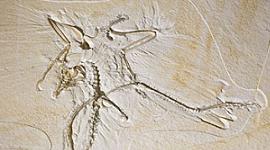
Using X-ray technology produced by electrons moving at or near the speed of light, scientists in Wyoming will get a picture of a flying dinosaur bird from the late Jurassic period according to USA Today.Â
The Archaeopteryx (pronounced aR-kee-OP-ter-iks) was a 16-inch-long flying dinosaur with sharp teeth and pointed talons on the end of its wing according to initial studies of the newly found fossils. The fossils being studied were found in Germany but moved to the Wyoming Dinosaur Center for further study.Â
“It’s kind of like a bird stuffed up a dinosaur’s butt,” said University of Manchester paleontologist Phil Manning, one of the researchers.
The remains of the Archaeopteryx were entombed in limestone after the creature died and fell into a shallow lagoon full of very salty water, creating an “amazing fossil.”  The remains are one of only 10 Archaeopteryx fossils found in the world and are importnat because it was a crossover species. Scientists hope to study it and discover more about evolution in motion as the Archaeopteryx are an example of one branch of dinosaurs morphing into what would become the ancestors of birds.Â
The original idea of using new X-ray technology on fossils came from engineer and chemist Robert Morton of the Children of the Middle Waters Institute. His day job is doing chemistry for oil companies, which means he thinks about how to get information about things that might be hidden in very old rocks, such as oil. He heard a talk in the late 1980s and realized that the technique described could also be used to “see” the chemical ghosts of fossils.
Scientists at the Stanford Synchrotron Radiation Lightsource (SSRL) at the SLAC National Accelerator Laboratory, operated by Stanford University for the U.S. Department of Energy, are using this new method to tease out secrets that were embedded in the stone all those millions of years ago. The secrets may tell us more than we ever knew about how the Archeaopteryx lived and flew — and maybe even give us a few hints on how to store spent nuclear fuel as well.
The researcher are using synchrotron radiation, which produces intense X-ray beams, to build an elemental image of the creature. A single, intense beam is slowly scanned across the surface of the fossil.
As the X-ray bounces off the surface of the fossil, it creates a unique pattern that reveals the chemical composition of the remnants of the animal that are still preserved in the stone. Sometimes even those remnants are gone, but because other chemicals flowed in during fossilization to take their place in a fairly orderly manner, scientists can reverse-engineer what they see to imagine what once was there. The technique is called X-ray fluorescence imaging.
This enormous waterfall of data is then fed into a computer program that allows scientists to create an image of the leavings of a list of different elements — calcium, phosphorous, sulfur, zinc, copper and others. Seen alone or layered over one and other, they give an image of the “ghost” of a body that disintegrated millions of years ago, leaving only tiny traces of the elements it was made of behind.
Although the scan will be completed today, scientists will be working on the data for months. Then they’ll submit it for publication in a scientific journal. By the conventions of the world of science, they can’t release any images of anything new they’ve found before the paper comes out.
So, it won’t be for at least a year or more that we see images of this species. Maybe they’ll be released in time for “Jurassic Park 4.”Â

Leave a Reply