NASA is celebrating a landmark — 50 years since it was first instituted as the United States’ chief agency for space exploration. It has had to take a lot of brunts over this past half century, but being a slave to congressional budgets, that is expected and the price one has to pay for being an arm of the government. However, NASA has a lot to be proud of over the course of its existence and MSNBC’s John Roach took a few minutes to highlight at least 10 of NASA’s FIRST’s and most important moments, tragedies and contributions to history, space exploration and travel “where no one has gone before.”
1961: First American in space
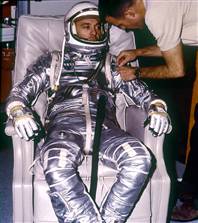
With the Cold War raging and the U.S. lagging behind the Soviet Union in the space race, Alan Shepard’s 15-minute suborbital trip to space could not have come at a better time. Weeks earlier, the Soviet cosmonaut Yuri Gargarin orbited Earth to become the first human in space, stoking concern about U.S. inferiority. A series of exploded NASA rockets underscored the sense of gloom. Shepard’s flight aboard his Freedom 7 capsule reinvigorated the U.S. space program — and national pride. Less than a year later, John Glenn made America’s first orbital flight.
1965: First U.S. spacewalk
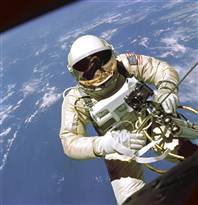
Astronaut Ed White floated out the hatch of the Gemini 4 capsule on June 3, 1965, for what he called “the greatest experience” — the first U.S. spacewalk. He was tethered to the capsule with a 25-foot-long umbilical cord and spent the first three minutes maneuvering with a gas-powered gun held in his hand. After the fuel ran out, he twisted his body and tugged on the cord to get around. He said the order to return to the vehicle after his 23-minute sojourn was the “saddest moment” of his life.
1967: First NASA tragedy
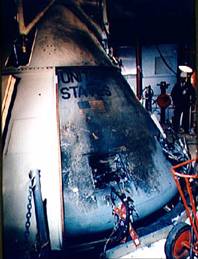
America’s first space tragedy occurred right here on Earth. Astronauts Gus Grissom, Ed White and Roger Chaffee were running through training exercises atop a NASA launch pad in Florida when an accidental fire ripped through the Apollo 1 spacecraft. Unable to escape, the three men died from smoke inhalation, delivering a tremendous setback to the space agency’s moon program. NASA launched a full-fledged investigation into the accident, which the agency determined was caused by an electric arc in an oxygen-rich atmosphere. NASA fixed the problem and returned to spaceflight, a pattern it would repeat following the Challenger tragedy in 1986 and the Columbia tragedy in 2003.
1969: First moon landing
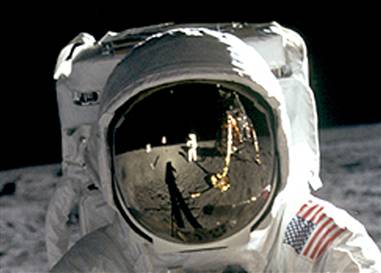
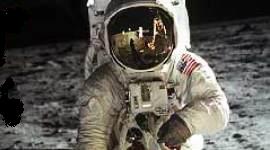
“The Eagle has landed.” Those words, spoken by astronaut Neil Armstrong from the surface of the moon on July 20, 1969, made it look as if Americans could accomplish just about anything they put their minds to. In a historic 1961 speech to Congress, President Kennedy outlined the goal to safely land an American on the moon as part of his plan to catch up with, and overtake, the Soviet Union in the space race. As Armstrong climbed out of the Eagle and onto the lunar surface, his words rang true around the world: “That’s one small step for a man, one giant leap for mankind.” In this image, astronaut Buzz Aldrin’s helmet visor catches the reflection of Armstrong, who was busy taking photos of the historic event.
1973: First U.S. space station
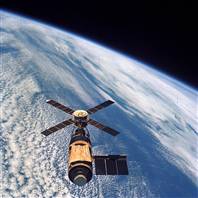
The Soviets beat the U.S. in the race to put a science lab in space with the launch of Salyut 1 in 1971, but NASA followed with Skylab in 1973. The 100-ton spacecraft with 10,000 cubic feet of living room gave NASA its first opportunity to learn about long-duration life in space. Soviet and U.S. space officials later decided to collaborate on long-duration space research, a partnership that includes experiments aboard the international space station.
1976: First U.S. probe on Mars
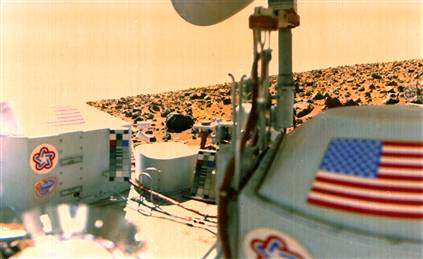
The Viking landers touched down on the surface of Mars in the summer of 1976 and opened the world’s eyes to another planet. The first Mars landers sent back stunning images of the Red Planet’s surface and dug around for signs of life. Though the biological findings were inconclusive, the Viking mission set the stage for generations of orbiters, landers and rovers to come.
1981: First space shuttle flight
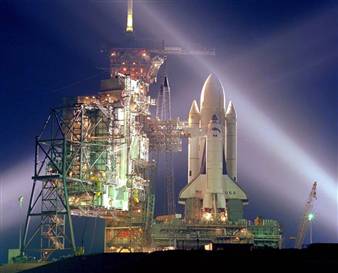
Commander John Young and pilot Robert Crippen opened a new era of human spaceflight at NASA with the successful launch of space shuttle Columbia on April 12, 1981, from Kennedy Space Center in Florida. The astronauts put the reusable spacecraft through 54 hours of testing, such as opening its payload doors and checking thrusters, before landing safely at Edwards Air Force Base in California. Though the shuttle program never lived up to its promise of frequent and low-cost launches, it has been a remarkable workhorse.
1990: First light for Hubble
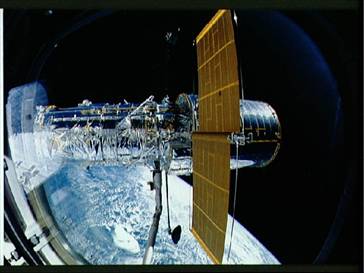
April 25, 1990, was the day the space shuttle gave space science one of its biggest gifts: deployment of the Hubble Space Telescope. But the joy was short-lived. A month later, scientists learned the telescope’s main mirror was flawed, providing out-of-focus images of outer space. Oops. Three years later, NASA launched an ambitious rescue mission to outfit the space telescope with corrective lenses, marking the agency’s most successful comeback. NASA is planning one more service call to the aging telescope, a shuttle mission that could keep the eye in the sky operating for at least another five years.
1997: First road trip on Mars
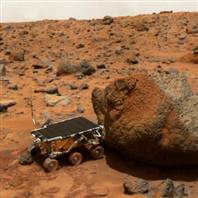
NASA’s Mars Sojourner rover, part of the Mars Pathfinder mission, was the first robotic rover to roll on the Red Planet. Millions of Web surfers clicked along as it checked out rocks with cartoon-character names such as Scooby Doo, Barnacle Bill and Yogi. The investigations conducted by the “first interplanetary robotic geologist,” as Sojourner became known, revealed hints about Mars’ volcanic and watery past. Sojourner’s successors, Spirit and Opportunity, continue to explore the planet today.
2000: First crew for international space station
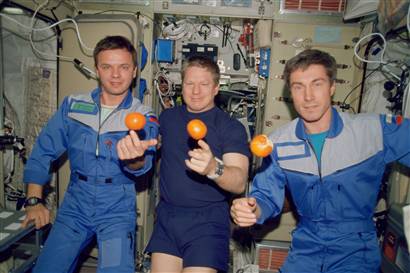
On Nov. 2, 2000, a Soyuz spacecraft delivered two Russians and an American commander to the international space station, launching an ongoing permanent human presence in space. The Expedition 1 crew members, NASA’s William Shepherd and Russia’s Sergei Krikalev and Yuri Gidzenko, spent four months aboard the station, mostly getting the frontier outpost ready for pioneering science experiments. Construction of the station is continuing, with the last pieces scheduled for delivery in 2010.
Happy Birthday NASA and hopes for many many more to come.