Written by: Robert Roy Britt (Senior Science Writer for Space.com)
A comet that has delighted backyard astronomers in recent weeks after an unexpected eruption has now grown larger than the sun.
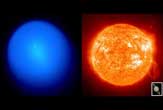 The sun remains by far the most massive object in the solar system, with an extended influence of particles that reaches all the planets. But the comparatively tiny Comet Holmes has released so much gas and dust that its extended atmosphere, or coma, is larger than the diameter of the sun. The comparison is clear in a new image.
“It continues to expand and is now the largest single object in the solar system,” according to astronomers at the University of Hawaii.
The coma’s diameter on Nov. 9 was 869,900 miles (1.4 million kilometers), based on measurements by Rachel Stevenson, Jan Kleyna and Pedro Lacerda of the University of Hawaii Institute for Astronomy. They used observations from the Canada-France-Hawaii Telescope. The sun’s diameter, stated differently by various sources and usually rounded to the nearest 100, is about 864,900 miles (1.392 million kilometers).
Separately, a new Hubble Space Telescope photo of the comet reveals an intriguing bow-tie structure around its nucleus.
The comet’s coma—mostly microscopic particles—shines by reflecting sunlight.
See for yourself
Holmes is still visible to the naked eye as a fuzzy star anytime after dark, high in the northeast sky. You can find it by using this sky map. It is faintly visible from cities, and from dark country locations is truly remarkable.
“Right now, in a dark sky it appears as a very noticeable circular cloud,” said Joe Rao, SPACE.com’s Skywatching Columnist. Rao advises looking for the comet this weekend, before the moon becomes more of a factor. The comet will likely diminish in brightness yet remain visible for the next two to three weeks, he said.
“Over the next few weeks and months, the coma and tail are expected to expand even more while the comet will fade as the dust disperses,” Stevenson and her colleagues write.
On Monday, Nov. 19, the comet will create a unique skywatching event with its see-through coma, according to the Web site Spaceweather.com: “The comet will glide by the star Mirfak [also called Alpha Persei] and appear to swallow it—a sight not to be missed.”
A small telescope will reveal the fuzzy coma. Lacking a long tail characteristic of some great comets, however, Holmes is not the most dramatic object in the sky for casual observers.
Mystery outburst
Nobody knows why Holmes erupted, but it underwent a similar explosive brightening in 1892. The recent display, which began Oct. 24, brought the comet from visual obscurity to being one of the brighter objects in the night sky. It has since dimmed somewhat as the material races outward from the nucleus at roughly 1,100 mph (0.5 km/sec).
The Hawaiian astronomy team writes in a press statement: “This amazing eruption of the comet is produced by dust ejected from a tiny solid nucleus made of ice and rock, only 3.6 kilometers (roughly 2.2 miles) in diameter.”
The new image from the Hawaiian observatory also shows a modest tail forming to one side, now just a fuzzy region to the lower-right. That’s caused by the pressure of sunlight pushing on the gas and dust of the coma.
But the comet is so far away—149 million miles (240 million kilometers), or about 1.6 times the distance from Earth to the sun—that even Hubble can’t resolve its nucleus.
The offset nature of the coma, seen in ground-based images, suggests “a large fragment broke off and subsequently disintegrated into tiny dust particles after moving away from the main nucleus,” Hubble astronomers said in a statement today. The comet’s distance, plus all the dust, prevent Hubble from seeing any fragments, however.
Britt’s original article can be found HERE.

+from+the+3.6-meter+Canada-France-Hawaii+telescope+on+Mauna+Kea+showing+the+coma+at+869,900+miles+(1.4+million+kilometers)+in+diameter.+The+white+%27%27star%27%27+near+the+center+of+the+coma+is+in+fact+the+dust-shrouded+nucleus+of+the+comet.The+sun+and+the+planet+Saturn+are+shown+at+the+same+scale+for+comparison.+Credit%3A+University+of+Hawaii/CFHT+(comet);+NASA/Voyager+(Saturn);+NASA/ESA/SOHO+(sun))


Leave a Reply