NEW YORK (AP) — Kurt Vonnegut, the satirical novelist who captured the absurdity of war and questioned the advances of science in darkly humorous works such as “Slaughterhouse-Five” and “Cat’s Cradle,” died Wednesday. He was 84.
Vonnegut, who often marveled that he had lived so long despite his lifelong smoking habit, had suffered brain injuries after a fall at his Manhattan home weeks ago, said his wife, photographer Jill Krementz.
The author of at least 19 novels, many of them best-sellers, as well as dozens of short stories, essays and plays, Vonnegut relished the role of a social critic. He lectured regularly, exhorting audiences to think for themselves and delighting in barbed commentary against the institutions he felt were dehumanizing people.
“I will say anything to be funny, often in the most horrible situations,” Vonnegut, whose watery, heavy-lidded eyes and unruly hair made him seem to be in existential pain, once told a gathering of psychiatrists.
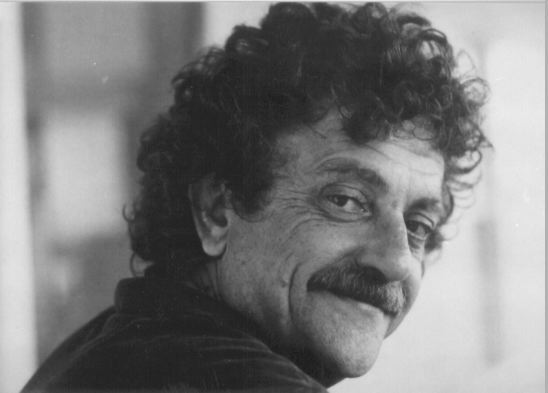 A self-described religious skeptic and freethinking humanist, Vonnegut used protagonists such as Billy Pilgrim and Eliot Rosewater as transparent vehicles for his points of view. He also filled his novels with satirical commentary and even drawings that were only loosely connected to the plot. In “Slaughterhouse-Five,” he drew a headstone with the epitaph: “Everything was beautiful, and nothing hurt.”
But much in his life was traumatic, and left him in pain.
A meat locker labeled slaughterhouse-five
Despite his commercial success, Vonnegut battled depression throughout his life, and in 1984, he attempted suicide with pills and alcohol, joking later about how he botched the job.
His mother had succeeded in killing herself just before he left for Germany during World War II, where he was quickly taken prisoner during the Battle of the Bulge. He was being held in Dresden when Allied bombs created a firestorm that killed an estimated 135,000 people in the city.
“The firebombing of Dresden explains absolutely nothing about why I write what I write and am what I am,” Vonnegut wrote in “Fates Worse Than Death,” his 1991 autobiography of sorts.
But he spent 23 years struggling to write about the ordeal, which he survived by huddling with other POWs inside an underground meat locker labeled slaughterhouse-five.
The novel, in which Pvt. Pilgrim is transported from Dresden by time-traveling aliens from the planet Tralfamadore, was published at the height of the Vietnam War, and solidified his reputation as an iconoclast.
“He was sort of like nobody else,” said Gore Vidal, who noted that he, Vonnegut and Norman Mailer were among the last writers around who served in World War II.
“He was imaginative; our generation of writers didn’t go in for imagination very much. Literary realism was the general style. Those of us who came out of the war in the 1940s made sort of the official American prose, and it was often a bit on the dull side. Kurt was never dull.”
A novelist — and car salesman
Vonnegut was born on Nov. 11, 1922, in Indianapolis, a “fourth-generation German-American religious skeptic Freethinker,” and studied chemistry at Cornell University before joining the Army.
When he returned, he reported for Chicago’s City News Bureau, then did public relations for General Electric, a job he loathed. He wrote his first novel, “Player Piano,” in 1951, followed by “The Sirens of Titan,” “Canary in a Cat House” and “Mother Night,” making ends meet by selling Saabs on Cape Cod.
Critics ignored him at first, then denigrated his deliberately bizarre stories and disjointed plots as haphazardly written science fiction. But his novels became cult classics, especially “Cat’s Cradle” in 1963, in which scientists create “ice-nine,” a crystal that turns water solid and destroys the earth.
Many of his novels were best-sellers. Some also were banned and burned for suspected obscenity. Vonnegut took on censorship as an active member of the PEN writers’ aid group and the American Civil Liberties Union. The American Humanist Association, which promotes individual freedom, rational thought and scientific skepticism, made him its honorary president.
His characters tended to be miserable anti-heroes with little control over their fate. Pilgrim was an ungainly, lonely goof. The hero of “God Bless You, Mr. Rosewater” was a sniveling, obese volunteer fireman.
Vonnegut said the villains in his books were never individuals, but culture, society and history, which he said were making a mess of the planet.
“We probably could have saved ourselves, but we were too damned lazy to try very hard … and too damn cheap,” he once suggested carving into a wall on the Grand Canyon, as a message for flying-saucer creatures.
He retired from novel writing in his later years but continued to publish short articles. He had a best-seller in 2005 with “A Man Without a Country,” a collection of his nonfiction, including jabs at the Bush administration (“upper-crust C-students who know no history or geography”) and the uncertain future of the planet.
He called the book’s success “a nice glass of champagne at the end of a life.”
Vonnegut, who had homes in Manhattan and the Hamptons in New York, adopted his sister’s three young children after she died. He also had three children of his own with his first wife, Ann Cox, and later adopted a daughter, Lily, with his second wife, the noted photographer Krementz.
Vonnegut once said that of all the ways to die, he’d prefer to go out in an airplane crash on the peak of Mount Kilimanjaro. He often joked about the difficulties of old age.
“When Hemingway killed himself he put a period at the end of his life; old age is more like a semicolon,” Vonnegut told The Associated Press in 2005.
“My father, like Hemingway, was a gun nut and was very unhappy late in life. But he was proud of not committing suicide. And I’ll do the same, so as not to set a bad example for my children.”